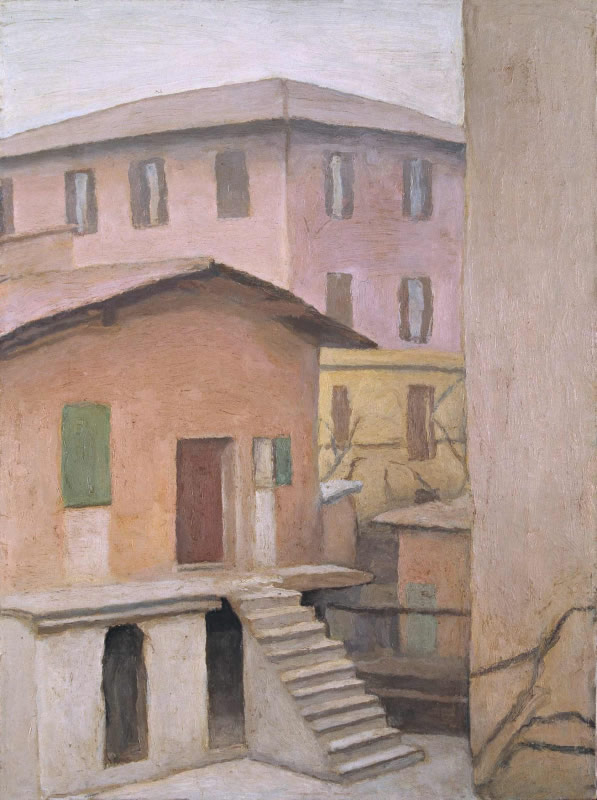

配色-方大扎大道庭院Cortile di via Fondazza
簡介:《方大扎大道庭院Cortile di via Fondazza》的配色圖,配色百分比和色值,本作品是畫家莫蘭迪色系于1959 年創作的一幅風景油畫繪畫作品。

配色數據:顏色百分比+色值 (配色基于AI視覺算法生成,點此反饋)
色環分布:小圓圈可選、可移動 ( 常用色環配色法→ )
作品名稱:Cortile di via Fondazza
中文名稱:方大扎大道庭院
創作時間:1959 年
畫作尺寸:40.5 x 45.5 cm
繪畫類型:風景油畫
流派:自成一派
題材:城市風光
原文介紹:
The starting point for Morandi’s complete ?uvre is the everyday utilitarian object, household items such as dishes, jars, bottles, jugs, mugs and vases, which, by the use of elaborate arrangements, he places in ever new mutual associations. Starting from these real situations – which also include the view from the window – Morandi creates a basic repertoire of motifs which he uses in order to pursue, all the way to the borders of abstraction, his confrontation with painterly elements such as form, colour and volume.
In numerous different combinations, which he creates in a meticulous selection procedure and places against a monochrome, neutral background, he tirelessly plumbs the mutual relationships between things, painstakingly studying the effect of light and shade, as well as the interplay of contours, spatial co-ordinates and areas of colour in a variable compositional structure. The objects which Morandi carefully places, as if on a stage, are often re-arranged and exchanged. Intervals are re-assessed, proportions changed, light-and-dark effects created. In this mise-en-scène, minor shifts in the arrangement give rise to crucial transformations of the whole picture. The multifariousness of the resulting variations meant for Morandi that the ‘encounter of a coffee-pot with a vase on a table remained an unsolved and highly relevant problem right up to his death in 1964’ (C. Spies). In addition, Morandi explores the relationship between occupied space and the unoccupied space in between, allowing contours to stand out in contrast, so that even the empty spaces in the picture are given, so to speak, an outline and thus a concrete presence. As with the sort of puzzle picture where background becomes foreground and vice versa, the result is sometimes a confusing, not to say irritating, equivalence of positive, filled-in areas on the one hand, and negative, deliberately empty, areas on the other. The existential distinction between presence and absence is abolished. Released from their real-life context, the depicted objects often lose their spatial and temporal orientation, while their silent, statuesque presence comes across as archaic and timeless.
As a result, Morandi succeeded in bestowing a certain monumentality of the miniature status of his humble motifs, so that the jugs and vases, as stand-alone entities in space, take on the gravity of buildings. Although Morandi vigorously rejected any relationship with Pittura Metafisica, with which he grappled in 1918 and 1919, and saw his artistic endeavours more in the context of the Italian masters of the Trecento and Quattrocento, his compositional structures, in their painstaking balance between filled and unfilled pictorial zones, contain echoes of the staffage of Giorgio de Chirico’s stage-like, usually deserted public spaces.
Morandi does not strive for a faithful reproduction of a reality bound to real space, but is concerned, rather, with the artistic shaping of the pictorial space, with the exploration of painterly possibilities. ‘The only interest the visible world arouses in me,’ he once wrote, ‘concerns space, light, colour and forms.’ These fleeting phenomena create a changeable reality, which is hard to pin down. Morandi shared this concept of reality, which is not unchanging and constant, but can be experienced in the alternation of moods and impressions, with Paul Cézanne, who placed the individual gaze, the subjective artistic perception, and the artificiality of the aesthetic experience above the mere reproduction of reality. While the Cubists dissected forms into their individual facets and the Futurists sought the dynamic dissolution of form in dense sequences of movement units, Morandi devoted himself to form in its changing manifestation. He created concentrated impressions reduced to their essentials, ‘impressions’ of this inconstant reality, whose elements ultimately, in his late work, almost dissolve into abstraction.
機器翻譯:
喬治·莫蘭迪 (1890-1964) 很少離開家鄉博洛尼亞,除了幾次瑞士之行外從未出國旅行,他周圍的環境始終是人們關注的焦點。觀察者莫蘭迪 (Morandi) 敏銳的眼光認識到平淡無奇的日常物品所固有的無窮無盡的多樣性,而這些多樣性可以通過仔細觀察來體驗。“一個人可以環游世界,什么也看不見。要了解一些東西,不需要看很多東西。人們只需要仔細檢查它們。(莫蘭迪)
莫蘭迪全部作品的起點是日常實用物品,如盤子、罐子、瓶子、罐子、馬克杯和花瓶等家居用品,他通過精心安排,將這些物品置于新的相互關聯中。從這些真實情況開始——也包括窗外的景色——莫蘭迪創造了一系列基本的主題,他用這些主題來追求,一直到抽象的邊界,他與繪畫元素如形式、顏色和體積。
在他精心挑選的眾多不同組合中,他將這些組合置于單色、中性的背景下,孜孜不倦地探究事物之間的相互關系,潛心研究光影效果,以及輪廓、空間協調的相互作用-可變組成結構中的坐標和顏色區域。莫蘭迪精心擺放的物品,就像在舞臺上一樣,經常被重新排列和交換。重新評估間隔,更改比例,創建明暗效果。在這種場面調度中,安排的微小變化會引起整個畫面的關鍵轉變。由此產生的變化的多樣性對莫蘭迪來說意味著“直到 1964 年他去世,咖啡壺和桌子上的花瓶的相遇仍然是一個未解決且高度相關的問題”(C. Spies)。此外,莫蘭迪還探討了被占用空間與未被占用空間之間的關系,讓輪廓在對比中脫穎而出,以至于畫面中的空白也可以說是有了輪廓,從而有了具體的存在。對于背景變成前景,反之亦然的拼圖圖片,結果有時令人困惑,更不用說惱人了,一方面是積極的,填充的區域,另一方面是消極的,故意留空的區域. 在場與不在場之間存在的區別被廢除了。從他們的現實生活中釋放出來,
結果,莫蘭迪成功地為其不起眼的圖案賦予了一定的紀念性,使水罐和花瓶作為空間中的獨立實體,呈現出建筑物的重力。盡管莫蘭迪極力拒絕與 Pittura Metafisica 有任何關系,他在 1918 年和 1919 年與之抗爭,并且更多地在意大利 Trecento 和 Quattrocento 大師的背景下看到他的藝術努力,他的構圖結構在填充和未填充之間進行了艱苦的平衡圖片區,包含 Giorgio de Chirico 舞臺般的工作人員的回聲,通常是空無一人的公共空間。
莫蘭迪并不力求忠實再現與真實空間相結合的現實,而是關注繪畫空間的藝術塑造,探索繪畫的可能性。“我對可見世界的唯一興趣,”他曾經寫道,“與空間、光線、顏色和形式有關。” 這些轉瞬即逝的現象創造了一個多變的現實,很難確定。莫蘭迪與保羅·塞尚分享了這種現實的概念,現實不是一成不變的,而是可以在情緒和印象的交替中體驗到的,他將個人的凝視、主觀的藝術感知和審美體驗的人工性置于藝術之上。僅僅是現實的再現。立體主義者將形式分解成各個方面,而未來主義者則在密集的運動單元序列中尋求形式的動態分解,而莫蘭迪則致力于形式不斷變化的表現形式。他創造了濃縮的印象,簡化為它們的本質,對這種變化無常的現實的“印象”,其元素最終在他后期的作品中幾乎溶解為抽象。
原畫TIF大圖下載:
暫無大圖
2、本資源部分來源其他平臺或互聯網收集,如有侵權請聯系及時處理。